Mid-Acts water baptism

Clete

Truth Smacker
Silver Subscriber
I had Gemini read "The Plot" (2013 edition) and I asked it this question: "Is there water baptism in Romans 6"?

Here's what it said:

According to the provided text, Romans 6 refers to spiritual baptism, not water baptism. The text makes the following points regarding baptism in Romans 6:

  • Baptism into Christ's Death: Romans 6:3-4 describes believers being "baptized into Christ" and "buried with Him through baptism into death". The author interprets this as the mechanism by which each believer "dies to the law through the death of Christ" individually.
  • Identification with the Body: The text links the baptism in Romans 6 to the baptism by the Spirit into the Body of Christ described in 1 Corinthians 12:13 ("For by one Spirit we were all baptized into one body").
  • Contrast with Water Baptism: While the Bible presents "various baptisms" (washings) that were symbolic, the author identifies the "baptism by the Spirit into the Body" as the one "most importantly, for Christians today".
  • Effect of this Baptism: Through this spiritual baptism, sinners are "delivered from the law". The author argues that this deliverance occurs "only when they die to it... as they are baptized into the Body of Christ (Rom. 6:3-4)".
Alright, your AI experiment is a perfect opportunity that should allow us to land this plane.

I think at this point it should be pretty clear why debates about water baptism never actually get resolved. The problem isn’t that the verses are unclear, and it isn’t that one side is being dishonest. The problem is that the disagreement isn’t really about baptism at all. It’s about the framework being used to interpret the text.

If you start with a sacramental or covenantal paradigm, you are going to see water baptism in passages like Romans 6. If you start with a Mid-Acts framework, you are not. Both sides can point to the same verses, make arguments that sound perfectly reasonable, and accuse the other of question begging. In a sense, both are right to do so, because both are reasoning from prior commitments that the other side does not share.

That’s why appealing to something like The Plot, or even feeding it into an AI and asking for an answer, doesn’t actually prove anything. All that demonstrates is that if you assume a Mid-Acts framework, you will get a Mid-Acts answer. You don’t need AI for that. Anyone who accepts that paradigm will arrive at the same conclusion. The answer is coming from the system, not from the text considered in isolation.

As I've said a few times already. I’m not arguing against the doctrine itself, except by proxy. I personally agree that Romans 6 is speaking about our identification with Christ in His death, burial, and resurrection, and that this is a spiritual reality, not something water can accomplish. What I am pushing back on is the idea that this reading is so obvious that any other view is automatically wrong. It isn’t. The text is capable of being read differently, and the fact that it consistently is, by serious and competent readers, proves that the issue does not find it's center of gravity in the text itself.

This is why trying to debate water baptism directly is a mistake. You can’t win that debate in any meaningful sense, because you are arguing about a conclusion while leaving the premises untouched. As long as two people are operating from different paradigms, they will continue to read the same passages differently, and no amount of back-and-forth over individual verses is going to resolve that.

If someone actually wants to settle the issue, the discussion has to move upstream. It has to deal with the framework itself. How should Scripture be divided? What is the relationship between the ministries of Peter and Paul? What defines the Body of Christ? How does progressive revelation function? Those are the questions that determine how passages like Romans 6 are understood.

Until those questions are addressed, debates about water baptism will continue to go in circles. Not because the participants are careless or irrational, but because they are starting from different first principles. If those first principles go undefined and unstated then they are going to look exactly like question begging because without that underlying framework, that's what they are.

So the real issue is not whether Romans 6 “includes” or “excludes” water baptism. The real issue is which framework best accounts for the totality of Scripture. Until that is established, you’re not actually debating baptism. You’re just watching two different systems produce two different answers from the same text. You simply cannot establish either position with proof-texts. It doesn't work because the texts change meaning based on the paradigm that is in place when those texts are read.

This is what makes The Plot such an incredibly important and profound work of theology. It addresses first principles and over arching principles and then lets the details fall into place within that framework. In my view, all theological debates should be predicated on paradigm level premises. Everything else is mostly a waste of energy.
 

Right Divider

Body part
Alright, your AI experiment is a perfect opportunity that should allow us to land this plane.

I think at this point it should be pretty clear why debates about water baptism never actually get resolved. The problem isn’t that the verses are unclear, and it isn’t that one side is being dishonest. The problem is that the disagreement isn’t really about baptism at all. It’s about the framework being used to interpret the text.

If you start with a sacramental or covenantal paradigm, you are going to see water baptism in passages like Romans 6. If you start with a Mid-Acts framework, you are not. Both sides can point to the same verses, make arguments that sound perfectly reasonable, and accuse the other of question begging. In a sense, both are right to do so, because both are reasoning from prior commitments that the other side does not share.

That’s why appealing to something like The Plot, or even feeding it into an AI and asking for an answer, doesn’t actually prove anything. All that demonstrates is that if you assume a Mid-Acts framework, you will get a Mid-Acts answer. You don’t need AI for that. Anyone who accepts that paradigm will arrive at the same conclusion. The answer is coming from the system, not from the text considered in isolation.
There is no such thing as "from the text considered in isolation", as you've just pointed out.

So, is it the case that YOU do not use a "Mid-Acts framework"?
Are you using an Act 2 framework? What is YOUR framework?

As I've said a few times already. I’m not arguing against the doctrine itself, except by proxy. I personally agree that Romans 6 is speaking about our identification with Christ in His death, burial, and resurrection, and that this is a spiritual reality, not something water can accomplish.
:unsure: You sure sounded like you cannot agree that Romans 6 is dry, in previous posts.
What I am pushing back on is the idea that this reading is so obvious that any other view is automatically wrong. It isn’t. The text is capable of being read differently, and the fact that it consistently is, by serious and competent readers, proves that the issue does not find it's center of gravity in the text itself.
That's NOT what you've said many times in this thread.

You've said, multiple times, that the "plain reading" of several texts requires YOUR reading of water baptism.
This is why trying to debate water baptism directly is a mistake. You can’t win that debate in any meaningful sense, because you are arguing about a conclusion while leaving the premises untouched. As long as two people are operating from different paradigms, they will continue to read the same passages differently, and no amount of back-and-forth over individual verses is going to resolve that.

If someone actually wants to settle the issue, the discussion has to move upstream. It has to deal with the framework itself. How should Scripture be divided? What is the relationship between the ministries of Peter and Paul? What defines the Body of Christ? How does progressive revelation function? Those are the questions that determine how passages like Romans 6 are understood.

Until those questions are addressed, debates about water baptism will continue to go in circles. Not because the participants are careless or irrational, but because they are starting from different first principles. If those first principles go undefined and unstated then they are going to look exactly like question begging because without that underlying framework, that's what they are.

So the real issue is not whether Romans 6 “includes” or “excludes” water baptism. The real issue is which framework best accounts for the totality of Scripture.
BINGO!!!
Until that is established, you’re not actually debating baptism. You’re just watching two different systems produce two different answers from the same text. You simply cannot establish either position with proof-texts. It doesn't work because the texts change meaning based on the paradigm that is in place when those texts are read.

This is what makes The Plot such an incredibly important and profound work of theology. It addresses first principles and over arching principles and then lets the details fall into place within that framework. In my view, all theological debates should be predicated on paradigm level premises. Everything else is mostly a waste of energy.
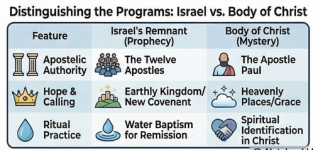
It's funny that this whole conversation started because of your thoughts on this little graphic.

1774649488098.png
 

Clete

Truth Smacker
Silver Subscriber
There is no such thing as "from the text considered in isolation", as you've just pointed out.

So, is it the case that YOU do not use a "Mid-Acts framework"?
Are you using an Act 2 framework? What is YOUR framework?
Virtually any framework at all other than a Mid-Acts framework will have biblical proof for water baptism all over the place.

:unsure: You sure sounded like you cannot agree that Romans 6 is dry, in previous posts.
I said it multiple times throughout this thread that I do not actually disagree with your doctrine on this issue.

That's NOT what you've said many times in this thread.
Because I was making the arguments that I've heard all my life and that I've read other make on this website for decades.

You've said, multiple times, that the "plain reading" of several texts requires YOUR reading of water baptism.
A point you could not refute without appealing to your doctrine - which has been my point all along.

I'm not sure why this wasn't your reaction from the start. That's surely more my fault than yours.

It's funny that this whole conversation started because of your thoughts on this little graphic.

View attachment 15467
Yes, and when I read it again, I get the same feeling in my gut. The entire bottom row is problematic. It is, at best incomplete because it makes no mention of the Lord's Supper and thereby implies, or at least the way I'm reading it seems to imply, a prohibition against ritual that simply does not exist in the Body of Christ.
 

JudgeRightly

裁判官が正しく判断する
Staff member
Administrator
Super Moderator
Gold Subscriber
There is no evidence that they were anything else.

Aside from all the evidence that I laid out in everything I said after this sentence in my post, sure, no evidence at all.

Did you not notice the list? (That's rhetorical, don't answer that. I know you did.)

Almost every single verse, as well as the context itself, has something that points to them being Jews, or at the very least proselyte Gentiles.

They received the Holy Spirit via Paul laying hands on them.

As I already pointed out, The Holy Spirit came upon them AFTER they were baptized, AFTER Paul laid hands upon them, according to the text.

Members of the Body of Christ are baptized WITH the Holy Spirit. We aren't baptised THEN receive the Holy Spirit.

That and the fact that this occurs years after the Jerusalem council (long after Israel was cut off and the previous dispensation had ended) is proof positive that these men were definitely members of the Body of Christ.

You and I BOTH know that's not as strong of an argument as you are trying to portray it as, since we both acknowledge there was a transitional period after God cut off Israel and turned to the Gentiles.

These men had John’s water baptism, which was a baptism of repentance, and after believing on Christ (i.e. Paul's gospel) they were baptized again in Jesus name.

Yes, and that was a baptism done with water, something the Jews were already known for doing, baptizing things with water. And baptizing people with water had become commonplace for them as well, at least for New Covenant believers.

Baptizing the about twelve men again with water is of course the natural thing to do for Jewish believers.

And Paul, as he stated in 1 Corinthians 9:20, was doing nothing more than the usual.

For though I am free from all men, I have made myself a servant to all, that I might win the more; and to the Jews I became as a Jew, that I might win Jews; to those who are under the law, as under the law, that I might win those who are under the law; to those who are without law, as without law (not being without law toward God, but under law toward Christ), that I might win those who are without law; to the weak I became as weak, that I might win the weak. I have become all things to all men, that I might by all means save some. Now this I do for the gospel’s sake, that I may be partaker of it with you.

Note that Paul wrote 1 Corinthians right after the events of Acts 19, thus it is directly relevant to this discussion.

Nothing in the text suggests this second baptism is anything other than water. (i.e. In Acts, when no qualifier is given, “baptized” = water, unless clearly stated otherwise.) That is the natural reading of the text.

I agree that Paul baptized them with water.

I strongly reject, based on the context, that they were or became members of the body of Christ as an outcome. Christians, yes. But not BoC.

No one switched their calling. They were already believers. Paul simply brought them an update I'llto their faith.
 
Top