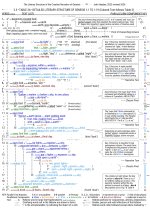
"The literary tapestry of Genesis is beautiful and inspiring.
The parallelism in the creation story is painterly and varying—employing all three parallelism types and nine different parallelism forms—yet the overall organization is precise and highly structured. The first impression of such a crafted composition is that it bears the hallmarks of a single creative mind and is unlikely to be assembled from disparate multiple sources.
Secondly, the found literary style is unique. It is neither simple prose nor poetry nor any of the typical biblical genres: Law, History, Wisdom, Poetry, Prophecy, and Apocalyptic Literature. It is unlike the adjacent chapters 2, 3, and 4, or the poetic style of Exodus 15, or its parallel narrative version in Exodus 14, or the narrative prose of Judges and Kings. It is a singularly unique, formally structured narrative of artfully overlaid polemic and parallelism components. It relays truth and counters untruth."
One might expect such uniqueness, as this is only event in the Bible that involves God alone.
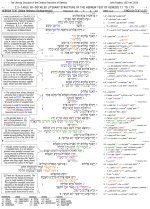
"3.2.1 Example 1 — Chiasm of Genesis 2:4.
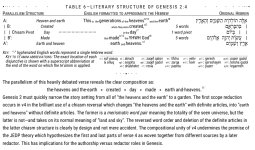
The chiasm of 2:4 is the first toldoth in Genesis, which transitions between the creation story and Genesis 2, 3, and 4. An analysis reveals a chiasm with an internal pivot on the word “day.” The parallelism of this heavily debated verse reveals the clear composition as:
the-heavens and the-earth / created / day / made / earth and-heavens.¹¹
Genesis 2 must quickly narrow the story setting from all of “the heavens and the earth” to a garden. The first scope reduction occurs in v.4 in the brilliant use of a chiasm reversal which changes “the heavens and the earth” (with definite articles) into “earth and heavens” (without definite articles).
The former is a merismatic word pair meaning the totality of the seen universe, but the latter is not—and takes on its normal meaning of “land and sky.” The reversed word order and deletion of the definite articles in the latter chiasm structure is clearly by design and not mere accident.
The compositional unity of v.4 undermines the premise of the JEDP theory, which hypothesizes the first and last parts of verse 4 as woven together from different sources by a later redactor. This has implications for the authorship versus redactor roles in Genesis."
Now this was fascinating. It was the first time I've ever heard Gen 2:4 being described as a "toldoth". Normally "toldoth" refers to a particular part of the Jewish Triennial Cycle (annual reading), Genesis 25:19-28:9, where a detailed generational account is given involving Abraham's family line.
What the author is saying is that Gen 2:4 is "a toldoth" because it
also indicates a detailed generational account is going to be made. Involving what was "born" during the creation week in Gen 1. Land and Sky, Eden, Adam, Plants ect. In the same way that Gen 25:19 begins an account involving Abraham's lineage.
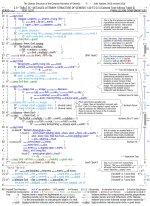
"3.2.3 Example 3 — Chiasm in Day 4.
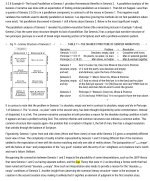
The chiastic parallelism on Day 4 is stunning. Yet scholars who are unaware of the Hebrew parallelism in Genesis 1 have imagined the text as the merger of two sources with “radically different” gods. One god is spatial-temporal, like the gods of ANE myths. The other god is a spiritual deity that “creates merely by uttering his divine fiat … radically different from the conception of a deity who makes and fashions things.”¹²
One such theory is the multiple-source Tatbericht and Wortbericht Theory, which proposes v.14–15 to the “word account” (Wortbericht) of the immaterial god and v.16–18 to the “deed account” (Tatbericht) of the material god.¹³
But with the parallelism structure of these verses in view at right (Figure 9), it is clear that the effect was intentionally crafted into the text by a single creative mind to provide a binocular view of the creation event. They failed to see God’s WORD and God’s WORK as parallel analogues.
Some scholars are aware of this error and its corrosive effect on Genesis (O. H. Steck, Wenham, Cassuto) and reject the multiple-source theory."
Here the author rebuts an argument old earthers typically make at Reasons to Believe, Bio-Logos forum ect.
"[Speaking of the serpents in Gen 1:21]These creatures of “great” size that are isolated in the text—specifically bara creations of God—were likely the mythical serpents from Babylonian, Egyptian, and Canaanite myths. There were many water and serpent deities; most pagan cosmologies have two or more.
There are the water gods Apsû and Tiamat of the Enuma Elish; or the Egyptian primordial water god Nun and the primordial sea serpent Nehebkau; or the sea serpent god of chaos Apophis (also known as Apep), who famously battles the Egyptian sun god Ra every night; or the Canaanite sea serpent Tunnanu (or Tannin).
Moses needs to displace all these in the minds of his primary audience for Genesis 1: former Egyptian slaves—the Hebrews—who were saturated in Egyptian beliefs for centuries."
This is all wrong. If for example, the serpents in Gen are related to Egyptian beliefs in any way, then the Egyptian belief is a corruption of the truth of the Creation -not an invented myth. Every well known scholar makes the same mistake. Michael Heiser used to do it all the time. Moses
was not the first human to have at least some knowledge of the Creation event. Adam was and his descendants would have retained at least some part of it. God Himself spoke to Adam's son, saying "Your brother's blood cries out
to ME." Yet they always speak of the Caananite and Egyptian beliefs
as if they came first and that Moses account was a "Johnny come lately".
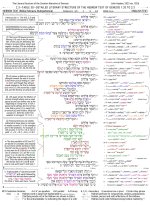
 "[Notes on Genesis 1:6–8]
v6b, 7a, 8a) Raqia is best rendered as “expanse.”
The LXX redefined raqia meaning “stretched” to stereoma meaning “firm or solid” in verses 6, 7, 8, 14, 15, 17, and 20. This became firmamentum in the Vulgate, which John Wycliffe transliterated into “firmament” in 1382 when he used the Latin Vulgate (not the Hebrew) as the source for the first English translation of the complete Bible. Then began the downward cascade of the errant “firmament” into English 16th–20th century translations (KJV, NKJV, ASV, ERV, JPS, Smith’s, Geneva, Bishops, Coverdale, Tyndale, and Douay-Rheims Bibles) (Hayden, A Literary and Cultural Analysis of the Creation Narrative of Genesis 1:1–2:3, Academia.edu, 2022 rev. 2026, p.20, 22).
v6b) In v.6 the “expanse” placement is betowk, which may be rendered as “in,” “within,” “midst,” or “among” the waters. Due to the varying word meanings, verses 6 and 7 are indeterminate if raqia is a boundary between or an effect on the waters. Psalm 148:4b uses identical wording and offers no clarification..
...v8a) This context indicates “sky” is the appropriate rendering rather than “heavens.”
Since Hebrew lacks a word for sky, samayim is used to mean both (1) the “sky” and (2) the elements seen in the sky or the “heavens” above. English readers will be misled by the use of “heavens,” since they will wrongly intuit it cannot be the sky because that word was not used."
Notice how the author struggles a bit here and how nicely Hydroplate Theory would fit, without obscuring the parallelism.